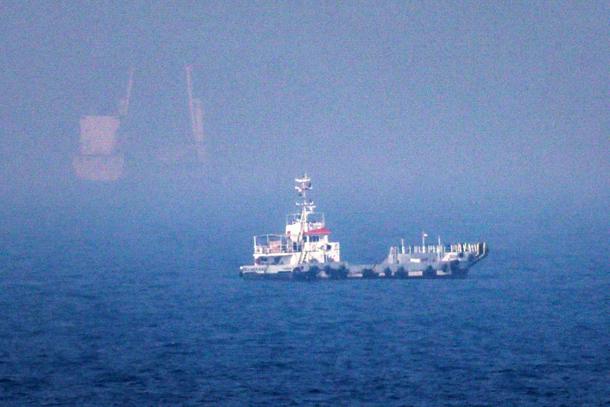
Ships sail near the Strait of Hormuz off the eastern coast of the United Arab Emirates at Khor Fakkan on July 13, 2026
Tehran (AFP) - The United States struck Iran and Tehran attacked US allies in the Gulf on Thursday as the foes battled over the vital Strait of Hormuz in the renewed Middle East war.
The rekindled fighting came a month after the signing of a preliminary deal that aimed to end the conflict, which broke out in late February with massive US-Israeli strikes on Iran.
US Central Command (CENTCOM) announced it was conducting a new wave of strikes on Thursday evening to “further degrade Iranian military capabilities” – the sixth straight night of attacks by American forces.
Iranian state TV reported two explosions in the city of Bushehr – home to Iran’s only civilian nuclear plant – in a “continuation of the American enemy aggression”, as well as a series of unattributed blasts in coastal Bandar Abbas.
The official news agency IRNA also said there were “American enemy attacks on areas around Ahvaz”.
Tehran had earlier warned it would target infrastructure across the region if US President Donald Trump followed through on a threat to attack power plants and bridges in Iran – though the White House said he remained “open to diplomacy”.
Iran’s Revolutionary Guards said Thursday that they struck a US airbase in Jordan with ballistic missiles in response to what they described as an American attack near a children’s cancer hospital, also near Ahvaz.
Later on, Iranian state media reported strikes on bridges and an airport in the southern part of the Islamic republic, near the Strait of Hormuz, which has been at the heart of the recent fighting and is crucial to global oil and gas flows.
- ‘Never back down’ -
Iranian state media said the hospital in Ahvaz, in the southwest, was evacuated following US airstrikes on the area that foreign ministry spokesman Esmaeil Baqaei slammed as “barbaric”.
Hani, a 34-year-old teacher from Ahvaz, said the strikes were “very intense”, adding: “My hands are shaking. There were at least 11, 12 explosions. My ears are exploding.”
US allies in the Gulf meanwhile responded to attacks, with Kuwait saying it intercepted Iranian drones and Bahrain sounding air raid sirens.
A senior Iranian military spokesman called for the US to withdraw from the region, saying “we will never back down over the Strait of Hormuz”, state TV reported.
The Strait of Hormuz was briefly reopened after the US-Iran deal in June, but Tehran said last week it would be closed again “until the US ends its aggression”.
The United States has also reimposed its blockade of Iran’s ports.
- Threats to infrastructure -
Pakistan’s foreign office spokesman, Tahir Andrabi, said Islamabad would “continue to encourage all sides to end violence and resume technical-level talks” under the memorandum of understanding it helped mediate last month.
But Iran’s top negotiator Mohammad Bagher Ghalibaf has warned that a deal “only has meaning when its clauses are valid and being implemented”.
White House Press Secretary Karoline Leavitt told reporters Thursday that Trump would hold Iran “accountable” for going back on its word, but said “he is always open to diplomacy at the very same time”.
“They have expressed they still want to make a deal to the president. We’re talking to them, but again, the president is not going to allow them to fire on ships in the strait without paying a consequence for that,” she said.
Trump previously threatened to hit Iranian power plants and bridges unless Tehran returned to the negotiating table, telling Fox News: ““Next week it gets really bad for them.”
On Thursday, the spokesman for Iran’s military headquarters said that if the US followed through on its threats, “all infrastructure in the region” would be “crushed”.
Since last week, renewed US attacks have killed at least 30 people in Iran, government spokesperson Fatemeh Mohajerani said.
burs-wd/sst