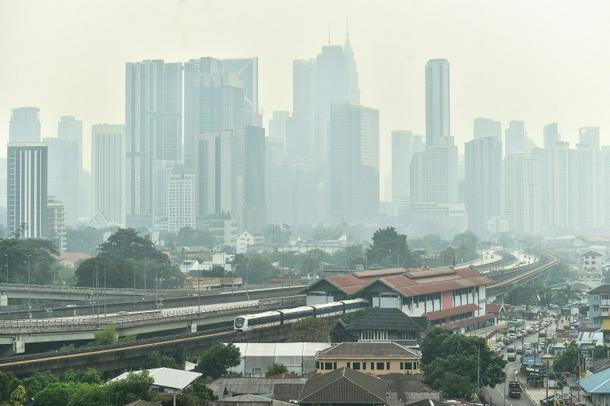
Toxic smoke from fires in Indonesia have forced school closures in Malaysia
Kuala Lumpur (AFP) - Malaysia closed schools in the capital and parts of the country on Friday as haze from fires in neighbouring Indonesia again reduced its air quality to among the world’s worst.
Toxic smoke from peatland and forest fires has shrouded towns and cities in the region for more than a month, sending respiratory complaints skyrocketing.
The school closures come as Malaysia’s Prime Minister Anwar Ibrahim discussed the choking smoke with his Indonesian counterpart and called for an urgent regional meeting.
Air quality in Kuala Lumpur has been at “unhealthy levels” this week, with a Swiss-based air quality monitor ranking the Malaysian capital among the world’s “most polluted global major cities” on most days.
Neighbouring Singapore late Friday said it too was “ready to roll out” a haze pollution plan should air quality levels deteriorate.
Singapore’s air quality levels hovered on the edge of “very unhealthy” levels late on Friday, according to the government’s Pollutant Standard Index (PSI).
- ‘Take precautions’ -
Anwar said he asked Malaysia’s Foreign Minister Mohamad Hasan to contact the 11-nation Association of Southeast Asian Nations (ASEAN) secretariat for an urgent meeting between environmental ministers to discuss the air pollution.
Malaysia’s Education Minister Fadhlina Sidek said she had instructed full school closures in four states and two federal territories as well as one partial closure in the central Pahang State.
Schools were also closed in three districts in western Perak State on Friday afternoon.
Malaysia’s King Sultan Ibrahim had also weighed in on the matter, saying schools should be closed as air quality readings reached 150 or higher on the Air Pollutant Index (API).
Under Malaysian guidelines, API readings above 100 are classified as unhealthy, above 200 as very unhealthy, above 300 as hazardous, while readings beyond 500 constitute the threshold for declaring a local emergency.
Kuala Lumpur on Friday afternoon showed a reading of around 224 on IQAir’s Air Quality Index, putting it in the “very unhealthy” range and briefly overtaking Singapore as the “most polluted global major city”.
Singapore’s National Environmental Agency (NEA) late Friday said it would distribute haze-rated masks to the public should air quality deteriorate.
Based on the current situation it is possible “that air quality levels “may enter the very unhealthy range,” the NEA said in a statement, adding that mask vending machines would be made available at public transport hubs and social service offices.
“While showers are expected over Singapore and the surrounding region on Saturday and Sunday, the prevailing southeasterly to southwesterly winds may continue to transport smoke haze from southern Sumatra and Kalimantan towards Singapore,” the NEA said, referring to the Indonesian regions where the fires are blazing.
The city-state is hosting its annual edition of the Formula 1 race over the weekend, but race organisers have said the toxic haze “did not represent a threat.”
“Air quality levels are being monitored by the relevant local authorities, and appropriate contingency measures are in place should conditions worsen,” organisers told AFP on Wednesday.
- ‘Shared concerns’ -
Malaysia’s Prime Minister said on Thursday he had discussed the situation with his Indonesian counterpart Prabowo Subianto.
“He also agreed to take the necessary steps,” Anwar said, without providing further details.
In Jakarta, the Government Communications Agency said such exchanges allowed the leaders to “discuss shared concerns”, without specifying what they were.
“Both countries look forward to constructive outcomes from these discussions that benefit their people and the wider region,” it said.
Anwar said Malaysia has been taking measures to combat the haze, including increasing attempts to trigger rain via cloud seeding.
Experts said the flames are being fanned by a turbo-charged El Nino weather phenomenon, causing the worst pollution conditions in years.
burs-jhe/ceg