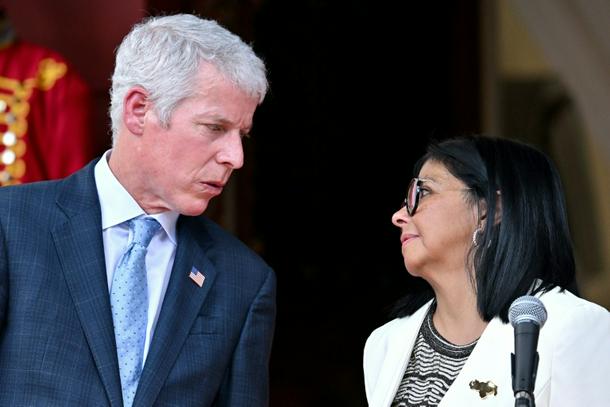
Venezuela's interim President Delcy Rodriguez and US Energy Secretary Chris Wright oversaw the signing of energy deals worth billions in Caracas
Caracas (AFP) - US energy firms on Wednesday signed a raft of multibillion-dollar deals with Venezuela, days after the South American country agreed to grant the United States control of a huge chunk of its vast oil reserves.
Energy Secretary Chris Wright traveled to Caracas to oversee the signing of deals worth “tens of billions of dollars of investment,” seen as a quid pro quo for Washington winning majority control of 65 billion barrels of Venezuelan oil reserves.
Wright said the deals signed by Venezuela with US oil major Chevron, GE Vernova, a General Electric offshoot, and Italy’s ENI were “critical in starting this ball rolling of peace, opportunity, and prosperity” in Venezuela.
Speaking alongside interim President Delcy Rodriguez, he argued that ramping up energy production was “the catalyst for transforming Venezuela” and for “improving the life conditions of Americans, the hemisphere and everyone in the world.”
President Donald Trump has talked up the agreement on Venezuela’s oil reserves as “the biggest “biggest oil deal in world history.”
It comes as US Republicans brace for possible losses in November midterm elections due to spiraling fuel costs brought on by his war against Iran, and a broader national affordability crisis in housing, food, utilities and other basic needs.
But the deals have raised major questions about Venezuela’s sovereignty.
Critics in both the United States and Venezuela accuse Trump of holding the country for ransom after ousting former president Nicolas Maduro in a bombing raid and warning that Rodriguez could face a similar fate if she doesn’t fall into line with Washington’s demands.
On Wednesday, Rodriguez denied she was surrendering her country’s riches, saying that cutting the United States in on Venezuela’s oil wealth is necessary to secure investment in the oil sector.
More oil “translates into more jobs, higher wages, better public services, hospitals, schools and food,” she said.
Rodriguez has estimated that Venezuela will make $209 billion in profit from the deals over 25 years.
- ‘Large volumes’ -
The new contracts signed Wednesday will see US company Chevron and Italy’s ENI ramp up their operations in Venezuela while gaining greater stakes in the oil fields.
Chevron, the top private oil producer in Venezuela, has valued its deal to develop two additional oil fields in the Orinoco Belt at $7 billion and projects output will more than double in five years time.
ENI said it had gained exclusive rights to explore the giant Junin 5 oil field.
US energy company GE Vernova, an offshoot of General Electric, meanwhile, will help repair Venezuela’s battered electricity grid.
Wright told CNBC that Venezuela’s oil production would top 2 million barrels per day by the end of the decade, double the level in January when US forces seized Trump arch-foe Maduro.
That would still be far off Venezuela’s peak of over 3 million barrels per day in the late 1990s.
The pivotal role in the deal played by a fraud-accused Venezuelan businessman, Alejandro Betancourt, has come under scrunity.
Betancourt has been linked to a corruption scandal at state oil company PDVSA and runs North American Blue Energy Partners (NABEP), Venezuela’s second-largest private oil company, in which the US government is taking a 35 percent stake under the deal.
Wright on Wednesday defended NABEP’s “highly successful track record of producing large volumes of oil in Venezuela,” adding: “That’s a business partner you can believe in.”
- ‘Not ready’ for elections -
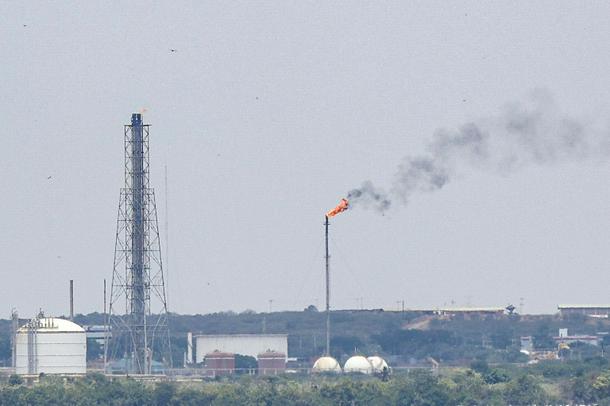
Rodriguez denied she was surrendering Venezuela's riches, saying that cutting the United States in on the country's oil wealth was necessary to secure investment in the oil sector
The agreement is a major about-face for the “Chavismo” movement of late socialist firebrand Hugo Chavez, Maduro’s mentor, who nationalized Venezuela’s oil fields two decades ago on an anti-imperialist platform.
It has amplified fears that the Trump administration is entrenching former Maduro loyalists, like Rodriguez – who have shown no readiness to hold democratic elections eight months after Maduro’s overthrow.
Trump on Wednesday rebuffed calls from a number of Republican lawmakers for quick polls in Venezuela.
“I just don’t think they’re ready yet. You know, it’s very new. We took them out of a dictatorship, and we’re getting along great with the government,” he said.
Rodriguez took a similar line, saying there would be “an electoral process” when “Venezuela is ready.”