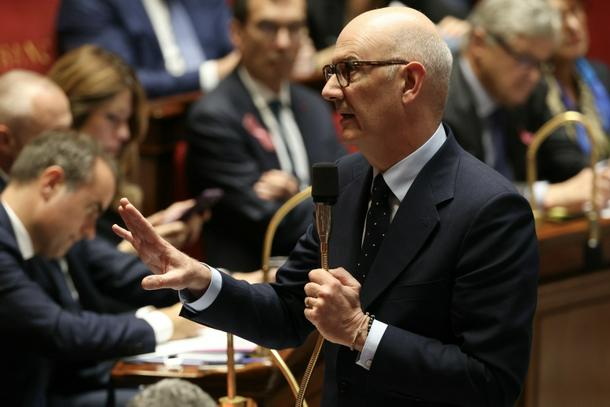
Finance Minister Roland Lescure is trying to get a 2027 budget that calls for billions of euros in spending cuts passed in Parliament
Paris (France) (AFP) - The French economy could be “headed for a wall” if the government is unable to pass a deficit-reducing budget soon, its finance minister warned Friday, a day ahead of new nationwide protests over the soaring cost of living.
His warning came as the national statistics office reported that the country’s economy has not grown so far this year and contracted in the last quarter.
France has been rocked by widespread anger over the rising cost of living and inequality, with authorities warning of a “very high risk of public disorder” this weekend, after protests two weeks ago degenerated into some of the country’s worst rioting in years.
“If we fail to achieve the turnaround outlined in the budget, we are headed straight for a wall,” finance minister Roland Lescure told France Info radio.
“For three quarters now, there has been no growth,” Lescure said.
“The conclusion to be drawn from all this is that, as of 2026, the French economy is at a standstill.”
The national statistics office Insee calculated that gross domestic product – a key yardstick of a country’s economic health – shrank by 0.1 percent in the three months to September.
That spelled bad news for the government amid deepening concerns about public finances and growing political tensions ahead of presidential elections next spring.
The French economy had already stagnated in the second quarter after shrinking by 0.2 percent in the first.
The new contraction – which effectively puts the eurozone’s second-biggest economy on the brink of recession – came as inflation accelerated to 3.4 percent on an annualised basis in October from 3.1 percent in September, the fastest rate since January 2024, Insee said.
- Deficit targets in doubt -
Analysts said the growth data would indeed make it difficult for the government to reach its overall growth forecast of 0.5 percent for the current year or even the 0.4 percent anticipated by Insee and the Bank of France.
And that meant the government would have difficulty in reining in its deficit to 5.0 percent of GDP next year, already one of the largest budget shortfalls in Europe.
“We will begin 2027 from a very weak starting point in terms of growth,” said Allianz Trade economist, Maxime Darmet. This “raises questions about the credibility of deficit reduction efforts.”
Worries about France’s high debt and deficits have sent its government bond yields soaring in recent weeks.
An underwhelming 2027 budget plan last month fanned concerns that government spending would remain high ahead of next year’s presidential elections in which the far-right candidate Marine Le Pen, seen as a fiscal populist, stands a chance of winning, according to opinion polls.
However, with growth falling short of expectations, “the deficit will not shrink” from the 5.4 percent projected for 2026, Darmet said.
With interest rates on French debt already at their highest level in over two decades, there was a risk of “a vicious cycle: weak growth leads markets to demand an even higher risk premium, which in turn weighs on growth, and so on,” the analyst argued.
“The outlook is rather bleak,” agreed Sylvain Bersinger of the consultancy Bersingeco.
One particularly pessimistic scenario would be for “a prolonged political and budgetary crisis,” particularly “if the upcoming elections fail to provide a clear political direction.”
The public debt crisis “could worsen, plunging the country into an economic and political crisis far more severe than the one we are currently experiencing,” Bersinger said.