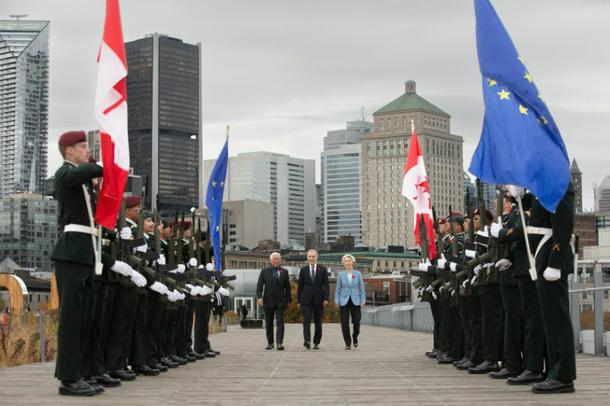
The EU and Canada want to strike a closer alliance
Montreal (Canada) (AFP) - The EU and Canada announced an alliance Friday aimed at cementing their own relations in the face of President Donald Trump’s moves to tear up US ties with its old partners.
Canada agreed to contribute to a 90-billion-euro ($103 billion) support loan for Ukraine and work closer with Brussels on anything from critical minerals to artificial intelligence, after a two-day summit in Montreal.
“The world’s becoming more dangerous and divided. Our societies are being shaken by new storms,” Canadian Prime Minister Mark Carney told a press conference, mentioning eroding democratic norms and “the weaponization of trade.”
“Together, Canada and the European Union are anchoring the ground. Anchoring our ground to uphold our values while forming a protective canopy under which our citizens can all thrive,” he said after talks with EU chiefs Ursula von der Leyen and Antonio Costa.
Already sharing a free trade agreement, Canada and the EU have sought to move closer together since Trump’s shock return to power.
Both Canada and the EU have been hit with US tariffs and territorial threats.
In Montreal, they sketched out a two-tier partnership that von der Leyen, the European Commission president, stressed was “not against anyone else, but for our common strength.”
But the plan was partially overshadowed by an intra-EU squabble over what the new relationship should be called, which led to some mixed messaging at the summit.
Unable to fully join the bloc, Canada would become its first “associate member,” von der Leyen, said doubling down on a term opposed by Germany and a handful of other EU states.
The group had successfully pushed to have the label dropped from a joint summit statement, arguing it doesn’t exist in EU treaties and needed defining.
Von der Leyen was, however, backed by Carney who also used the title as he addressed journalists after the talks, adding its “substance” would be determined in the coming months.
In Brussels’ view, the term defines the unique partnership the EU has with Canada and entails aligning policies, such as on climate and artificial intelligence, Canada joining some EU programs, and creating a stable governance framework.
- Broader alliance -
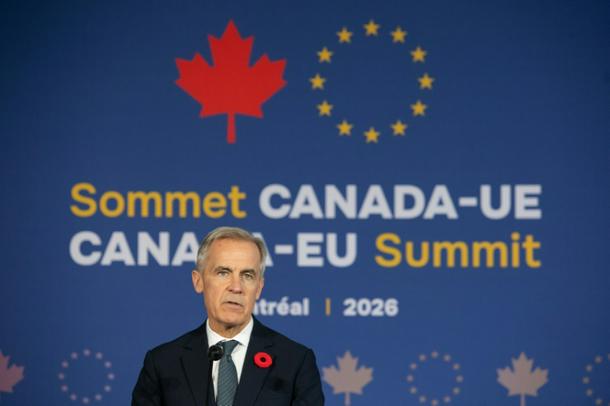
Canada will join the EU’s 90-billion-euro support loan for Ukraine
As part of this Canada will have a more stable presence at the EU table.
Carney will take part in an EU leaders summit in June and European commissioners and Canadian ministers would hold a separate meeting in the spring, Costa, the European Council president, said.
More broadly, Canada and the EU would form the “nucleus” of a larger “alliance for the future” open to other partners, von der Leyen said.
This “will focus on increasing our collective sovereignty and resilience in areas such as AI, energy, critical minerals, quantum, and beyond,” Carney said.
A senior EU official explained a key part of it would be coordinating economic security measures, like tariffs, so that they do not inadvertently harm members of the group.
To kick off work, Brussels and Ottawa signed a digital trade deal and a separate pact allowing the European Investment Bank to back Canadian critical mineral projects.
Canada is rich in rare earths and critical minerals Europe currently sources mostly from China but needs massive infrastructure investment to jump-start its mining industry.
The allies agreed to deepen cooperation on satellite connectivity and navigation and artificial intelligence – a field where they are playing catch-up with the US and China.
They also launched work towards Canada’s participation in EU initiatives like the Erasmus program, which allows university students to spend a semester abroad, and the Galileo satellite program – an alternative to the American Global Positioning System (GPS).
Europe opened its supercomputing infrastructure to Canadian researchers, industry and start-ups.
Finally, Carney said Canada will join the EU’s 90-billion-euro support loan for Ukraine with an initial participation of 500 million euros, in what von der Leyen described as “a powerful message” of support to Kyiv.
Brussels has been looking for help to plug gaps in Kyiv’s finances, as Russia’s war of invasion grinds on.